
Nov06
Friday, November 06 - Wednesday, November 18 11:00 a.m. - 6:00 p.m. CST at SAIC Galleries Lower Level 1


Learn how to prepare your artwork for Risograph printing using Photoshop. This workshop covers color separation, spot channels, halftones, and setting up files so your prints come out clean and vibrant. Perfect for beginners or anyone looking to better understand how digital files translate into Riso prints.
Riesling Dong is a Chicago-based book artist and graphic designer focusing on the interactivity of the book form and experimental publishing across print and digital formats. Riesling teaches in the Visual Communication Design department at SAIC and Spudnik Press. She works closely with artists to develop creative solutions within book arts. Her practice bridges technical processes and conceptual experimentation, treating books as dynamic, participatory objects.
Using found ephemera, paper materials, and sewing, Riley—designer and manager at Blue Daring, Chicago—will walk you through an explorative process to generate material studies, collage art, and generative textures.
Riley Brady is a designer and manager at Blue Daring, Chicago. Riley's background in digital design, studio art, and art history influences her elegant, conceptual style. Her specialties include publication design, branding, illustration, and all things print production. Riley’s conceptual and visually-harmonious work is rooted in her fine arts and art history backgrounds, which fuel her talent for creating brand stories with impact and complement the exceptional organization and project management skills that make her a natural manager. With a professional background that includes complex production, multimedia and motion-based design projects, she is passionate about achieving inclusivity and accessibility through design, and garners consistent praise for her vision and creativity.
Using P5Live, we'll explore creative coding with p5.js in a live coding environment, generating fullscreen visuals in the web browser. We'll also combine p5.js with Hydra (another visual framework inspired by the Sandin Image Processor), using HY5, which allows one to pass graphics between the two libraries for the best of both.
Raised in his parent’s hardware store, Joe has a lifelong fascination with how things work, and how to fix the things that need fixing. This engrained interest became the foundation for a career in production. As a producer, Joe has had opportunities working with celebs, Super Bowl, integrated campaigns, and now managing a team of producers. Grounded in his mom & pop shop upbringing, Joe employs a mix of technical knowledge, customer service, and a keen business sense to deliver innovative creative to solve client problems. In his current role he is most excited about fostering the team’s accomplishments and growth while engaging the next generation of producers to develop new solves for modern production challenges.
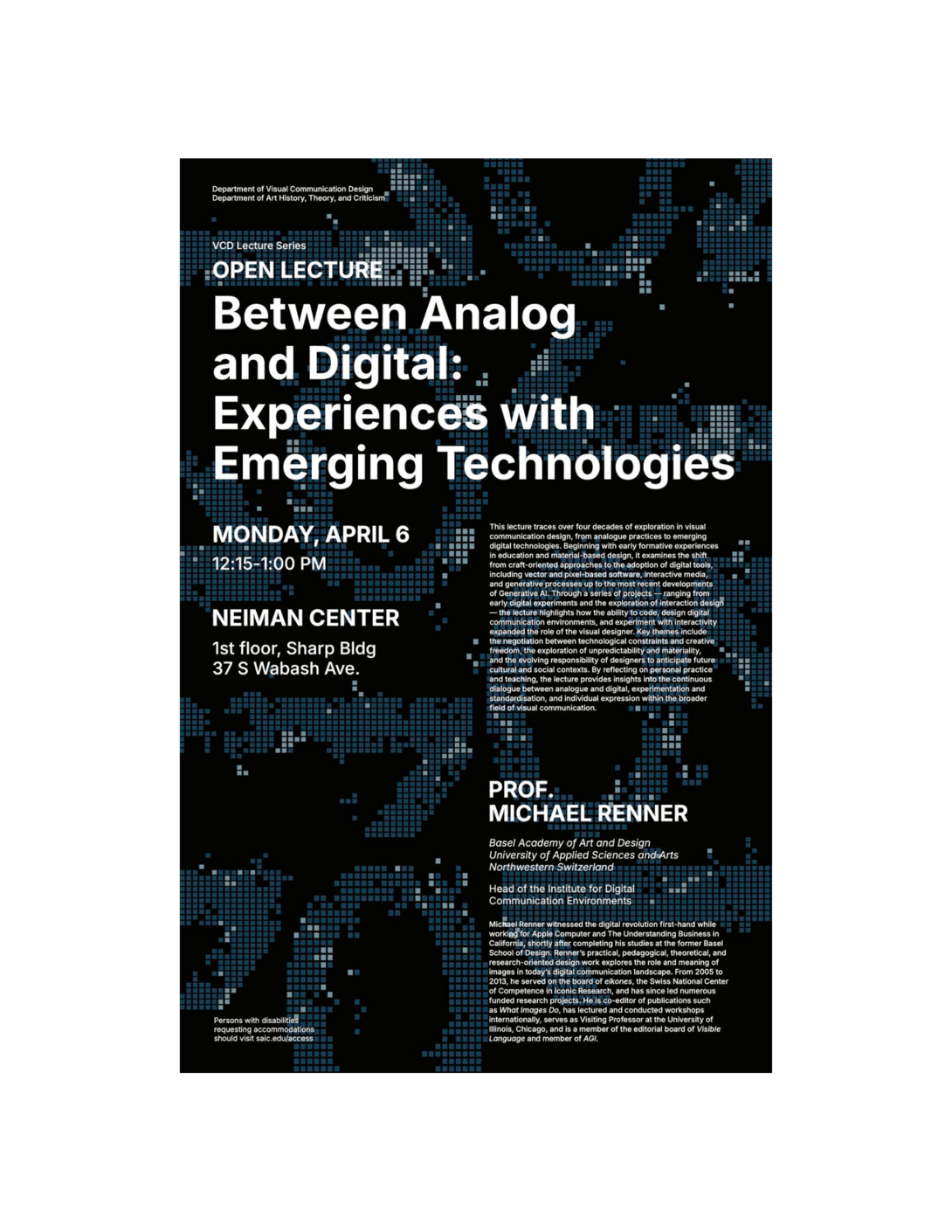
This lecture traces over four decades of exploration in visual communication design, from analogue practices to emerging digital technologies. Beginning with early formative experiences in education and material-based design, it examines the shift from craft-oriented approaches to the adoption of digital tools, including vector and pixel-based software, interactive media, and generative processes up to the most recent developments of Generative AI. Through a series of projects—ranging from early digital experiments and the exploration of interaction design—the lecture highlights how the ability to code, design digital communication environments, and experiment with interactivity expanded the role of the visual designer. Key themes include the negotiation between technological constraints and creative freedom, the exploration of unpredictability and materiality, and the evolving responsibility of designers to anticipate future cultural and social contexts. By reflecting on personal practice and teaching, the lecture provides insights into the continuous dialogue between analogue and digital, experimentation and standardisation, and individual expression within the broader field of visual communication.
Michael Renner is Professor of Visual Communication and Head of the Institute for Digital Communication Environments at the Basel Academy of Art and Design, Switzerland. He witnessed the digital revolution first-hand while working for Apple Computer and The Understanding Business in California, shortly after completing his studies at the former Basel School of Design. Renner’s practical, pedagogical, theoretical, and research-oriented design work explores the role and meaning of images in today’s digital communication landscape. From 2005 to 2013, he served on the board of eikones, the Swiss National Center of Competence in Iconic Research, and has since led numerous funded research projects. He is co-editor of publications such as What Images Do, has lectured and conducted workshops internationally, serves as Visiting Professor at the University of Illinois, Chicago, and is a member of the editorial board of Visible Language and member of AGI.
Cat Nguyen is an experienced cross-functional collaborator and senior UX lead who builds powerful yet approachable experiences. From UX flows, to copywriting, to engineering capabilities, to product strategy, Cat speaks your language. With varied and deep backgrounds in visual, mobile, privacy, and hardware UX, Cat's strengths are adaptability and tackling complexity.
Join us for a visit to Visual Communication's own Letterpress Studio! Experience the space with a first-hand demonstration by SAIC professor Cathie Ruggie-Saunders, and go home with your own print, using the letterpress machines.
This talk presents visual communication as a conversational practice, in which dialogue functions as a creative, critical, and relational tool that shapes how we learn, collaborate, and build shared understanding. Drawing on the MA Visual Communication programme at the Royal College of Art, student work from recent years will be discussed, exploring how proximity and participation function as core research methods. Through close engagement with people, places, and systems, the talk examines how visual practice generates forms of understanding grounded in lived experience and collaborative knowledge production. It considers how dialogue can move beyond exchange to become an active method of inquiry, experimentation, and public engagement, positioning visual communication as a space for collective thinking and shared meaning-making.
Mireille Fauchon is a graphic artist, writer, and researcher. Her practice-based research explores archival interpretation, visual storytelling, and social history, with particular attention to anecdotal narratives and the informal preservation of lived experience. She is co-editor of JOAN, a publishing project for contemporary writing, author of Illustration, Narrative and The Suffragette: An Illustrated Enquiry, and co-author of Illustration Research Methods, both published by Bloomsbury. She is a Research Tutor in Visual Communication at the Royal College of Art.
Tracey Waller is a designer, researcher, and academic leader shaping dialogic and participatory approaches to visual communication education. She leads the MA Visual Communication programme at the Royal College of Art and is recognised for redefining assessment through her Dialogic Assessment Model. She collaborates with communities and interdisciplinary partners to position visual communication as a space for shared authorship, collective inquiry, and pedagogic research.
This talk places Phillip’s most recent work, what he has been calling “goth biology,” into context with his older work on the experience of space and time in the emergence of genetic rationality and the use of grids for envisioning organisms. It begins by asking, "What happens to bodies, or parts of bodies, that don’t easily fit into the grids of biomedicine?" We all know these bodies well, as they are our bodies. These are the bodies in pain, the disabled body, the dying or aging body, and the bodies deeply scarred by trauma. It turns out that imperfect bodies help us find vital meaning and a sense of place as we traverse the haunted ruins of an increasingly abstract biomedical vision of embodiment.
Phillip Thurtle researches the affective-phenomenological domains of media, the role of information processing technologies in biomedical research, and theories of novelty in the life sciences. His most recent work, Biology in the Grid: Graphic Design and the Envisioning of Life (University of Minnesota Press, 2018), analyzes the cellular spaces of transformation in evolutionary and developmental biology research and the cultural spaces of transformation in popular culture.
VCD Students, how do you turn your creative interests into a sustainable career? This panel will offer real-world insights into what it means to build and balance a creative life after graduation. Join five inspiring creatives from our Visual Communication Department—working across illustration, digital expression, curatorial practice, museum collections, and design education—as they share how resourcefulness, adaptability, ingenuity, skill, and luck have guided their professional paths. Hear stories from their transdisciplinary design experiences, and gain practical tips on how to navigate your own path in today’s changing design world.
Panelists include Michal Janicki (Senior Design Lead, IDEO + VCD Lecturer); Lauren Johnson (Assistant Collections Manager, Mammals Department, Field Museum of Natural History + VCD Lecturer); Jen Lobo (Research Affiliate, Field Museum of Natural History + VDC Lecturer); Michele Washington (Designer, Researcher, Critic, Curator, Podcast Host + VCD Lecturer); moderated by Mark Addison Smith (SAIC Associate Professor + VCD Undergraduate Coordinator).
Four Visual Communication Design alumni—Sandra Hsu (BFA 2017), Nicole Lun (MFA 2017), Patrick Stoltman (BFA 2013), and Tifa Zhou (MFA 2013)—will share their experiences as designers post-SAIC, the evolution of their careers, insights into their fields, and much more in this panel discussion.
Jacek is a graphic designer, editor, curator, researcher, and educator. He currently works at the Academy of Fine Arts and Design in Katowice (PL) and RISD in Providence (RI). In his talk, Jacek Mrowczyk will explore the relationships between micro- and macro-typography in connection to medium and place. The presentation will begin with an examination of the smallest spatial relationships within and around letterforms, drawing on his professional practice in book design. It will then move on to examples of spatial illusions in typography, and finally to how typography in public space helps shape a place’s identity, tells its story, and serves as a tool for way-finding.
What defines Visual Communication design? The answer varies dramatically across designers and institutions. This talk examines how the Institute of Design (ID) at Illinois Tech approaches this question through our distinct philosophy and practice. Situated within a technology university while rooted in the Bauhaus history of humanizing technology, ID applies systems-level thinking and rational design methodologies to visual communication challenges. Ichikawa will highlight ID's program legacy, current pedagogical approach, and how their functional design perspective differs from—and complements—other interpretations of the field. In the background, we shall acknowledge that our complex, diverse world is made richer for having these varied approaches to visual communication, in turn making it indispensable in our visual landscape.
Philosophers love to tell others what to do and what to think. Philosophy of science, philosophy of language, philosophy of mind, philosophy of religion, and even philosophy of design—in these and other instances, philosophy stands outside of a practice in order to conceptualize, direct, or otherwise ground it. The preposition of tells the story of philosophy’s (transcendent) relation to what it theorizes: it remains at a distance from its objects of contemplation. But what if practices generated their own philosophical content? Indeed, what if philosophy was already in design, architecture, fashion, etc., it just needed to be nourished and cultivated? In this talk, that’s precisely what Nocek will argue: that the designed world is already philosophical, and that it’s always given expression to philosophical propositions—vis-à-vis how one might live, how we perceive the world, who or what should be included/excluded. What’s at stake, however, is ensuring that those expressions are ethically and politically just.
The Infoklasse is a specialized program for Information Design within the Visual Communication department at UdK Berlin. The lecture offers an insight into different approaches within the Infoklasse curriculum and how these have been applied in specific projects.
A five-part story of his career in design: what he thought he knew, what he didn't know, what he still doesn't know, and what he's learned. In his current role at Morningstar, Matthew Terdich leads the Corporate Design Office team, a group of global designers supporting employee experience, internal communications, work space and environmental graphic design, and corporate sustainability and financial reporting. He received a BFA and MFA in Graphic Design from the University of Illinois at Chicago and an MAS in Visual Communication from the Basel School of Design/FHNW, in Basel, Switzerland.
The distinctiveness of the Polish Poster School and its metaphorical language (sometimes even overused) allowed creators to juggle meanings and craft complex messages. This was especially evident in cultural posters, where the message was usually reduced to the title of a film, play, or exhibition. The Polish Poster School is often seen as an alternative trend to international modernism, with the value of the posters themselves perceived in purely artistic terms.
Nontsikelelo Mutiti is a Zimbabwean-born visual artist and educator. She is invested in elevating the work and practices of Black peoples past, present, and future; those whose narratives have been under-recognized, whilst also acknowledging all our interconnected histories. Mutiti’s work appears through a conceptual approach to design, publishing, archiving practices, and institution building.


