
Photo by Todd Gray
Curator Hamza Walker Returns to SAIC
After closing his landmark exhibition MONUMENTS in May, curator Hamza Walker—who returns to the School of the Art Institute of Chicago (SAIC) this fall as the Bill & Stephanie Sick Distinguished Visiting Professor—might reasonably be expected to slow down. The exhibition, which Walker helped organize at The Brick and Museum of Contemporary Art in Los Angeles, made quite a splash. Lauded as “the most significant” and “most audacious and contentious” show of the year, MONUMENTS brought together decommissioned Confederate monuments and works by contemporary artists, many of which were newly commissioned for the exhibition. But as Walker says: “No matter how big or small, it's on to the next show.”
A prolific curator who now directs The Brick after more than two decades at Chicago’s Renaissance Society, Walker has organized exhibitions across the country. This fall, he’s one of the featured speakers for SAIC’s Visiting Artists Program, where he’ll deliver a lecture and Q&A.
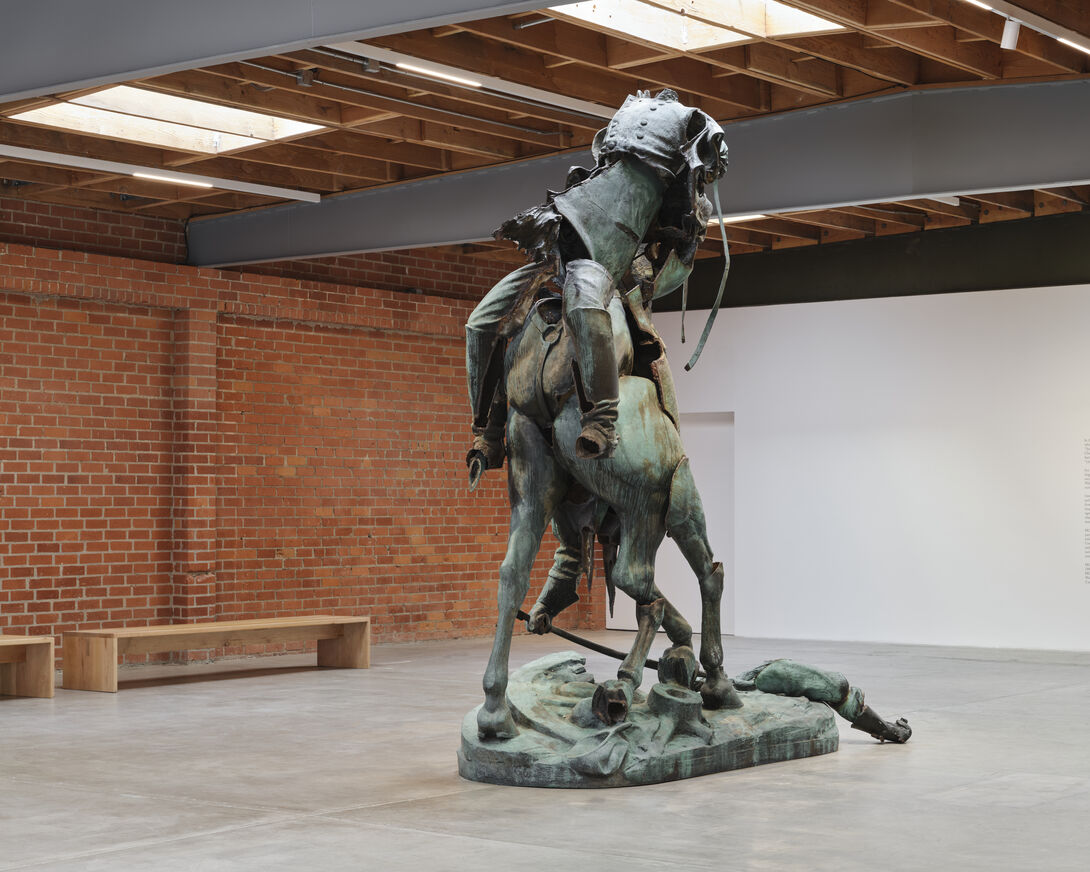
Kara Walker, Unmanned Drone, 2023/25 (The Brick) part of MONUMENTS, photo credit: Fredrik Nilsen
Then this spring, Walker will step into his visiting professorship, co-teaching a course on Miles Davis with longtime friend and SAIC Sound professor Lou Mallozzi. Walker’s interest in music is hardly separate from his curatorial work. Before joining the Renaissance Society, he cut his teeth organizing hyperlocal concerts in Chicago; decades later, when The Brick opened its new building in 2024, he marked the occasion with two performances by legendary saxophonist Roscoe Mitchell. A lifelong jazz aficionado, Walker has spent recent years diving into the biographies of the greats and ultimately found himself returning to Miles Davis.
Walker believes Davis’s career offers a critical lesson for all artists, not just musicians. “How do you change while remaining the same? What is the substance of that sameness?” Walker asks. “Miles Davis is a singular figure through whom you can narrate the history of jazz. The chapters, styles, periods, and moments in his career reflect broader developments in the history of the music. At the same time, as much as things change, things stay the same: he's still Miles.”
Walker is by no means new to teaching—he taught at SAIC for a decade in both the Painting and Drawing department and the Low-Residency MFA program. The ongoing creative exchanges with his students were a continual inspiration for Walker. “What young artists are looking at, what matters to them, and how paradigms shift over time can keep you on your toes and keep you fresh,” Walker said. “That’s what I like about teaching and what I look forward to.”
The return to teaching also means a return to Chicago. More than anything, Walker is looking forward to revisiting some beloved old haunts. While he was born in New York and grew up in Baltimore, Walker “came of age professionally in Chicago. You can’t rinse that out.” His itinerary includes old friends, burgers at Rootstock, jazz shows at Hungry Brain, and time spent wandering downtown: “It still cuts a figure.”
“It’s funny,” he said. “There are habittrails, muscle memory, routines, and rituals. But I also don't know the city anymore in a certain sense. I’m mindful of how things have changed. Ten years is a minute. It'll be good to see the new scenes and fresh blood.”
The John D. and Catherine T. MacArthur Foundation named alum Rodney McMillian (Post-Bacc 2000) one of its 2026 MacArthur Fellows.
