
Anxious Machines: August Marchand’s Fashion Thesis on Technology, Control, and Interface
Technology is often sold to us as sleek, seamless, and optimistic, an endless promise of progress rendered in polished glass and glowing screens. But in School of the Art Institute of Chicago (SAIC) student August Marchand’s thesis collection, technology feels heavier. Stranger. Less like a solution, and more like a system closing in.
Marchand explores the abstracted visual language of machines within his thesis project Quantum to explore how emerging technologies have become symbols of anxiety, oppression, and systemic limitation. Rather than imagining technology as a tool for liberation, his work confronts its colder reality: bleak, impersonal, and quietly controlling.
Here, Marchand discusses the evolution of his fashion collection, the visual tension between old and new futurisms, and how fashion became a way to process his uncertainty about what lies ahead. Weaving together motifs of monolithic technological structures such as servers racks, industrial reactors, and other utilitarian themes allows us to get an insight into Marchand’s outlook on the future.
What is the conceptual foundation of this collection?
I’ve really focused my collection around technology and the idea of emerging technologies representing anxiety for people. A lot of them have become symbols of oppression and systemic limitation rather than vehicles to uplift people. They serve their own interests. When I started, I was thinking a lot about symbols of technology and modern ideas of tech, but I wanted them to feel different from what we’re used to seeing. A lot of technological visuals feel very rooted in the ’90s or are overly polished and consumer-facing. I wanted something more unsettling—something that reflects how technology actually feels to live with now.
How did the visual language of the garments develop?
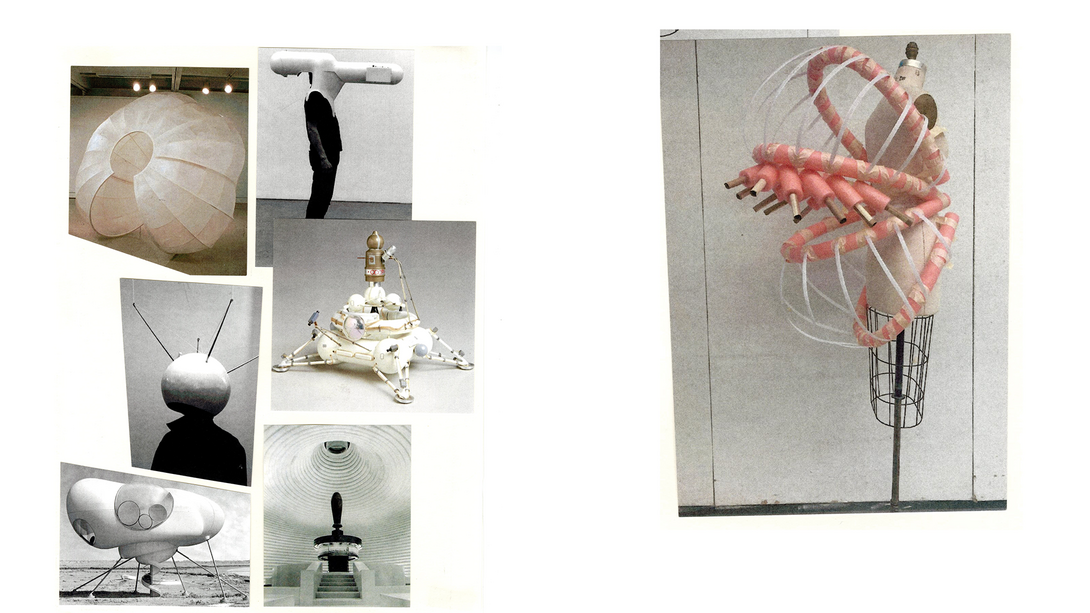
I started by looking at older ideas of technology and where those aesthetics branched off. I was really drawn to quantum computers—their forms are beautiful and alluring in this strange way. From there, I explored the current soft and accessible look of consumer technology. Products such as smart speakers and Ring cameras offer a rounded and soft look, despite housing technology that have led us to the surveillance state we’re currently barreling towards. Exploring this dichotomy informed a lot of my ideas and decisions within my collection, Quantum. From there, the process became very formal.
Are there particular looks that feel central to the collection?
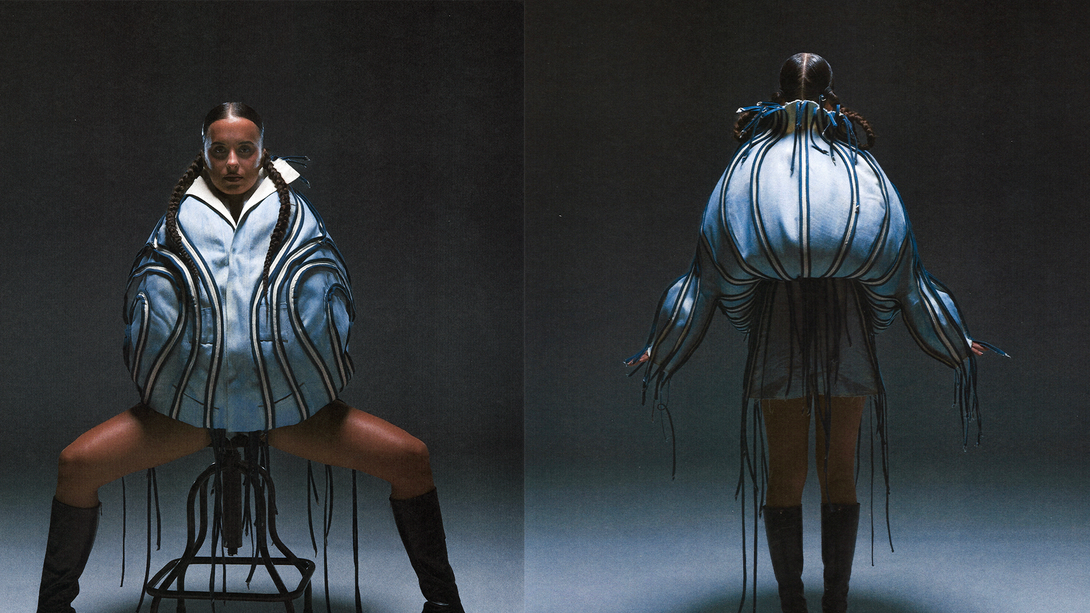
One of my favorite looks so far combines the two main styles I’m working between. The jacket leans into that smoother, consumer, abstracted idea of technology, while the sculptural elements at the hips reference quantum computers more directly. It’s where those two worlds really come together for me. Another look I’m still developing is more couture-focused, very formal, almost ballroom-like. It’s not meant for everyday wear, but it’s still grounded in the same ideas. Even when the silhouette shifts, the repetition of forms and concepts stays consistent across the collection.
Would you consider the pinnacle of your work at SAIC?
Definitely. I feel like I’m always growing, but this project really pulls together all of my skills, interests, and thoughts into one place. I get a lot of anxiety about the future, and this collection has become a way for me to process that. It’s also something I’ve been working toward for a long time, even before I realized it. When I spent an abroad semester at the art school Central Saint Martins, I unknowingly started laying the groundwork for this project. A denim project I did there ended up feeding directly into the design language I’m using now… it almost feels like a test run in hindsight.
Who’s been supporting you throughout your process?
[Assistant Professor] Edgar Aguilera and [Associate Professor, Adj.] Pam Vanderlinde have been my rocks this semester. I come to them with a lot of wild ideas, and they help put everything into place—from design consistency to the technical process of making the garments. Outside of that, my roommate Ravi Vietro has been incredibly supportive. I run so many ideas by him, and I’m grateful he’s always willing to listen. Marley Maidment has also been my forever fit model. He tries on everything before fittings so I can document it properly in my sketchbook. He’s been amazing throughout this whole process. Also would like to thank Payton Wright for helping me with the 3D modeling aspect of this journey.
It feels like it’s just a project, but it changes every day. From the start of the week to the end of the week, I’m somewhere completely different—thinking differently, making differently, pushing the work into new territory. That constant transformation is what makes it so exciting. It’s a really fun place to be, because I’m not trying to trap myself inside one idea anymore. I’m letting it move, letting it grow, and that’s been a really new and powerful development for me.
Emmy-winning writer Matt Price shares animation insights and career advice at CAPX’s virtual talk.
