
Look a Little Longer: The Art and Practice of SAIC Alum Alice Tippit
For Alice Tippit (BFA 2009, MFA 2013), painting is as much about language as image. Her canvases unfold like visual poems, built through metaphor, suggestion, and double meaning rather than straightforward representation. A curtain becomes a body, a tree stump a spotlight, an eye an egg. Familiar forms slip into unfamiliar ones, inviting viewers to read a painting the way they might read a poem: slowly, attentively, and with the understanding that meaning rarely arrives all at once.
That fascination with how words and images generate meaning reached a new audience this year with Rose Obsolete, Tippit's first solo museum exhibition at the DePaul Art Museum, and one of the museum’s final shows prior to its closure at the end of June. Bringing together more than a decade of paintings alongside murals, sculpture, and an expansive series of text drawings, the exhibition reveals an artist who treats looking as an act of interpretation. Her paintings ask not simply What do you see? but How? and Why?—why do certain forms, colors, and words carry meaning while others remain elusive?
Those questions have underpinned Tippit's practice for more than a decade, and came into sharper focus during her years at the School of the Art Institute of Chicago (SAIC).
Although she earned her BFA in 2009, painting was not always her intended trajectory. Working primarily on paper and across a variety of media for many years, she began to dwell more deeply on painting in Patrick and Dania Leemputte Chair in Painting and Drawing Gaylen Gerber’s courses, where she first explored working in oils. It was there that she recognized painting’s peculiar capacity for sustained questions. Later, in SAIC’s Advanced Painting courses, Associate Professor Scott Reeder and the late professor emeritus Theodore (Ted) Halkin (BFA 1949) became important mentors, fostering an environment of close looking and rigorous experimentation.
She returned to SAIC for graduate school wanting, as she puts it, to "read deeper into paintings"—to understand not simply how pictures are constructed, but how they communicate. Working with the late Barbara Rossi (MFA 1970) proved especially formative. With her guidance, Tippit learned to "calibrate," refining an attentiveness to what she describes as the "frequency" of an image, learning to tune into subtle shifts in color, shape, and composition until seemingly obvious forms revealed unexpected possibilities. It was less about finding answers than about sharpening perception.
That attentiveness remains central to her work. Tippit's paintings appear deceptively simple: flat expanses of carefully selected color, crisp freehand edges, singular objects suspended against an uncluttered ground. Yet beneath that immediate surface clarity lies a deep well of visual associations. References to art history, advertising, poetry, the body, and everyday objects allow a single form to signify several things at once. Looking becomes an act of translation.
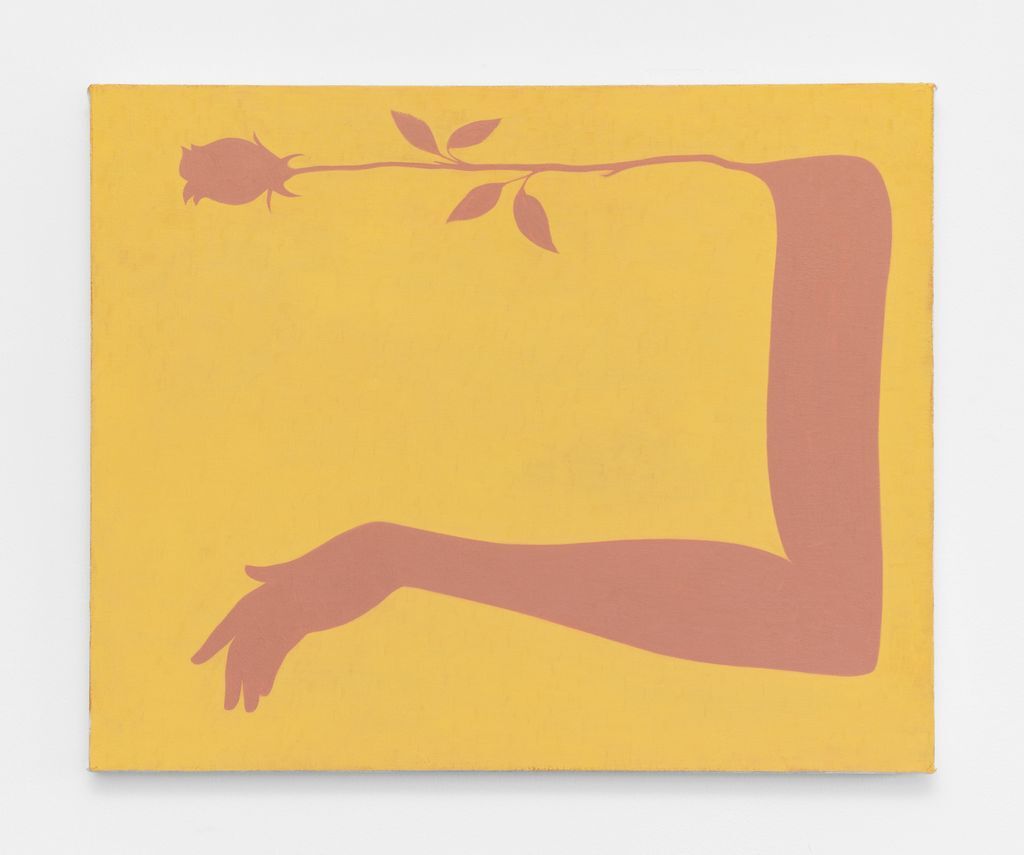
Alice Tippit, August, Oil on canvas, 18 x 22 inches (2026)
For Tippit, poetry offers an important model for this way of working.
She has long admired the poets Emily Dickinson and Gertrude Stein, whose compressed language creates expansive emotional and intellectual space. Like Dickinson's verse, Tippit's paintings often derive their power from what is implied rather than declared. They function through metaphor, omission, rhythm, and ambiguity, resisting singular interpretation while rewarding sustained attention. Stein's playful, unexpected juxtapositions that delight in the instability of language likewise resonate in Tippit's work, where familiar forms continually shift and words become visual objects of their own. Her enigmatic titles similarly refuse to explain the image, instead opening another path into it.
Rather than allowing text to explain a painting, or a painting to illustrate a phrase, Tippit has long been interested in dissolving the hierarchy between the two. Words could function visually, while images could behave poetically.
She traces that impulse back to experiments she undertook while at SAIC, including what she describes as her "calendar paintings," in which select words hovered over gridded spaces within the composition. Those early investigations planted questions that continue to animate her practice today: How do words operate as forms? How do images function like language? When does a painting become something to read rather than merely to look at?
Tippit returned to working with words as image around 2019, after a period of focusing on visual language. In 2024, she began the eponymous Rose Obsolete graphite drawings, which were among the first works she knew she wanted to include in the exhibition. Each drawing pairs two carefully rendered words in elegant cursive, following an intentional, recurrent structure of an irregular verb and another word. This formula is adapted, as is the series’ title, from William Carlos Williams’s 1923 poetry collection Spring and All: “The rose is obsolete / but each petal ends in / an edge.” These lines echo the drawings’ own play between language and image—rather than simply descriptive, the paired words become more evocative through visual proximity, inviting viewers to make their own associations.
Underlying these inquiries is a broader interest in ambiguity itself. Tippit describes her work as engaging with the kinds of questions that resist quick resolution. Human instinct, she observes, is to seek immediate answers, to settle uncertainty as efficiently as possible. Her paintings gently resist that impulse. Doorways, openings, thresholds, and passages recur throughout her work, not simply as visual motifs, but as an invitation to linger between meanings.
That openness extends to the trajectory of her own career.
In the years after graduate school, she found the friendships and connections from her time at SAIC provided some of the first opportunities to show her work. She recalls an invitation to exhibit at Night Club—a former apartment gallery founded in 2013 by then-undergraduate students Matthew Steinbrecher and Olivia Coran (BFA 2014)—leading to two solo shows, Little Grey Cells (2014) and Monk’s House (2016). Longtime friend and fellow alum Alex Chitty (MFA 2008) invited Tippit to collaborate on what would be their 2013 exhibition Ella Hatchet at Roots & Culture. Curator, founder of Devening Projects, and professor, adjunct Dan Devening was also an early supporter. These experiences shaped Tippit’s understanding that developing an audience and sustaining a practice takes time: after the success of Ella Hatchet, it was six years until she began working with PATRON Gallery, where she has since launched two solo exhibitions: Pallid Carrier (2020) and The Deep Element (2024).
Tippit describes this gradual traction through an unexpected metaphor: the creation of a pearl. Around an ordinary grain of sand, layers slowly accumulate until something luminous is formed. Interest builds incrementally as others encounter the work, return to it, and share it. Rather than imagining recognition as a sudden breakthrough, she sees it as the result of sustained attention over time.
This is a fitting analogy for Tippit’s paintings that, themselves, unfold through repeated looking. Nothing in Tippit's work insists on immediate revelation. Instead, her images invite viewers to linger, to allow meanings to emerge, dissolve, and reform. Like lines of striking poetry, they continue to resonate long after the first encounter, revealing new associations with every return.
That spirit of sustained inquiry remains one of the clearest throughlines from her years at SAIC to Rose Obsolete. The School offered not simply technical training, but the freedom to cultivate a practice grounded in careful observation and interdisciplinary thinking. For Tippit, the richest works of art do not resolve uncertainty; they deepen it, entrusting viewers to discover meaning in the act of looking itself.
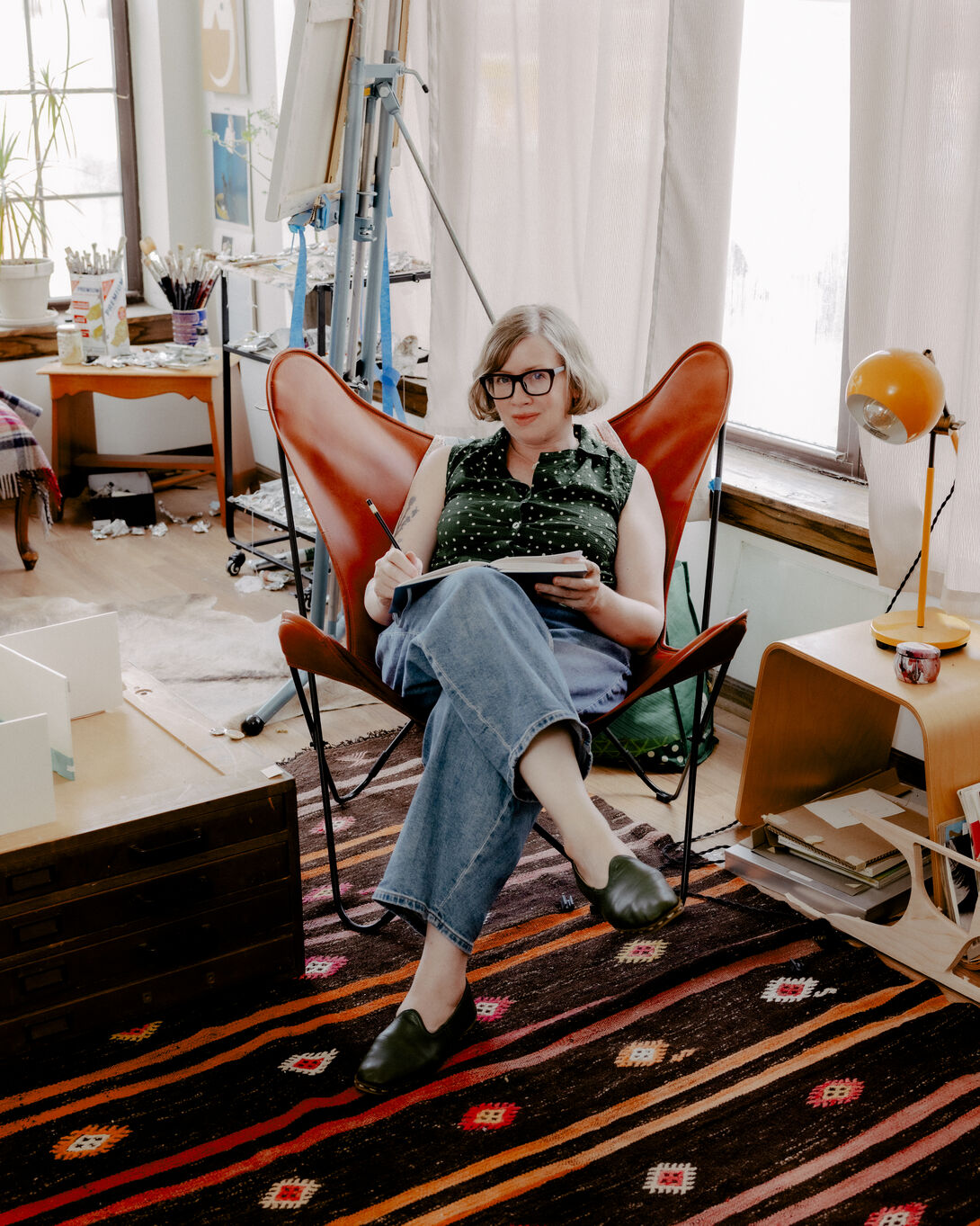
You can see Tippit's work in her solo exhibition Blue State, on view through October 10, 2026, at Nicelle Beauchene Gallery and in the monographic catalogue accompanying Rose Obsolete. Locally, she is represented by PATRON Gallery, where a selection of her work may often be found on view.
Professor Jan Tichy's exhibition on darkness and artificial light earns a New York Times profile.

Photo Credit: Anthony Valli/Arts MSU
Associate Professor Jan Tichy inside the Michigan State University planetarium, where he developed a new show exploring the science and art of darkness as part of his exhibition at the Eli and Edythe Broad Art Museum.