
Christmas Eve together with Peace, William McKnight Farrow
160 Years of Making... History: William McKnight Farrow
School of the Art Institute of Chicago (SAIC) alums have been making history over the last 16 decades! In our “160 Years of Making” series, we’re celebrating the people that shaped the School, Chicago, and the art world at large. Watch for more profiles as we honor this historic anniversary.
William McKnight Farrow Makes History
In 1927, the Art Institute of Chicago hosted one of the first-ever museum shows featuring the work of living Black artists. The show paired historic African pieces with modern sculptures and paintings, showcasing a wide range of Black creativity decades before the end of segregation. This revolutionary show was curated by Black artist and alum William McKnight Farrow (SAIC 1918).
After coming to Chicago to enroll at SAIC in 1908, Farrow was no stranger to breaking the status quo. Primarily a painter and printmaker interested in landscapes and portrait work, Farrow had works displayed at the Art Institute of Chicago and the South Side Community Art Center (where artists like alum Charles White (SAIC 1937–38) and Gordon Parks cited him as a major inspiration). He became the first African American instructor to teach at SAIC, and worked as a curator for the museum—including organizing the history-making 1927 show. In fact, he worked with the School and museum through 1945, holding the titles of head of the Printing Department, assistant curator of Exhibitions, and manager of Egyptian art.
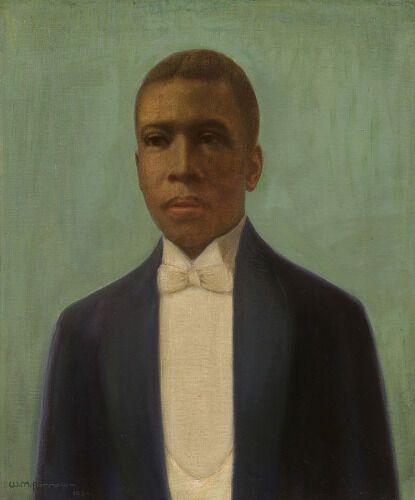
Though Farrow died in 1967, his work can still be viewed at the New York Public Library, the Metropolitan Museum of Art, and the National Portrait Gallery of the Smithsonian. He is remembered as a groundbreaking figure in the art world, a shaper of both arts institutions and pedagogy, and an inspiration to many major Black artists of the mid-20th century.
The School of the Art Institute of Chicago received a $1.5 million grant from the Korea Foundation to establish an endowed professorship in Korean Contemporary Art, Culture, and Media.
