
Where Art Meets Drag

By Nadya Kelly (MA 2023)
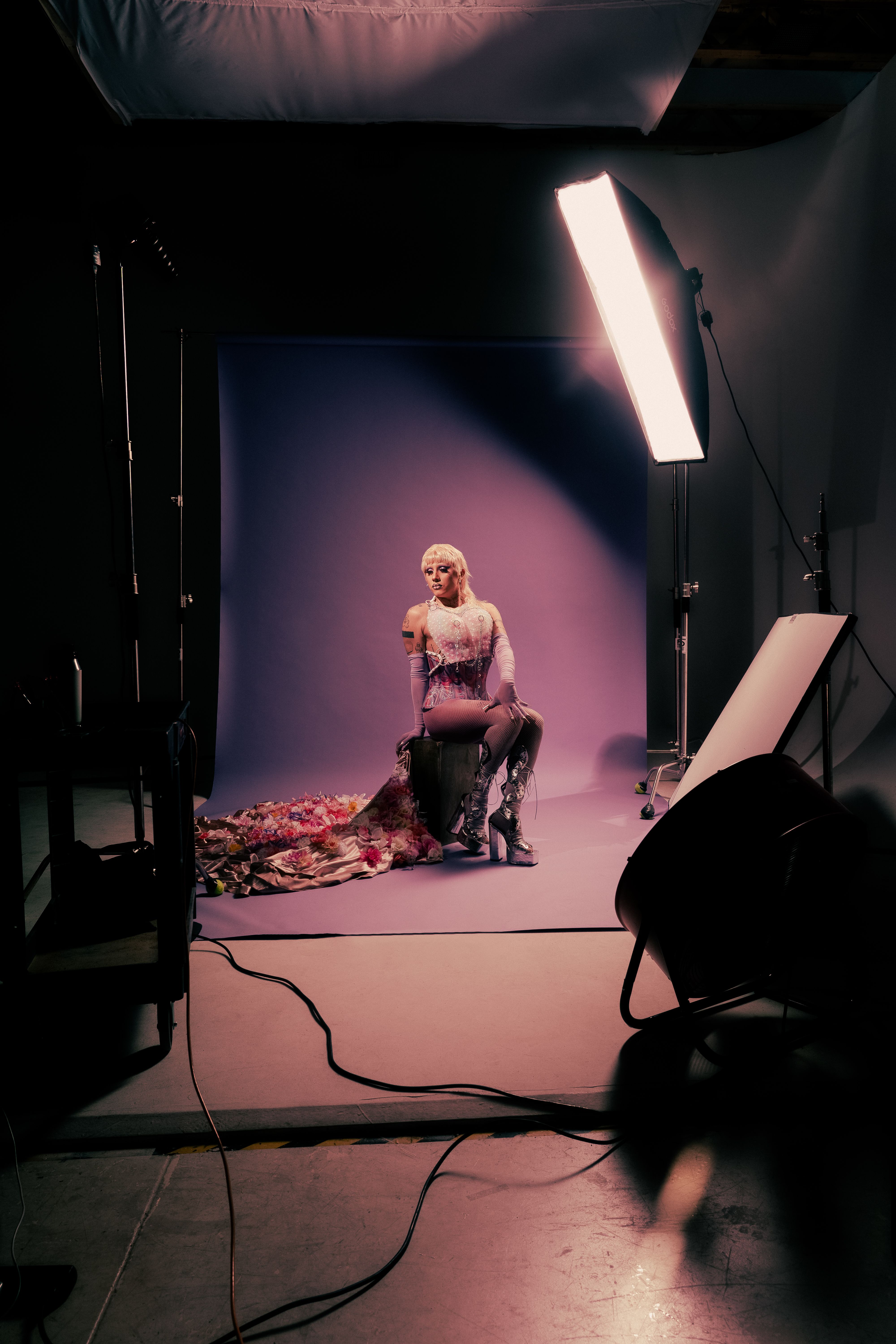
Inside the walls of a cocktail lounge, all eyes are on School of the Art Institute of Chicago (SAIC) alum Ále Campos (MFA 2022) as they perform a lip sync of Lady Gaga’s glam rock single “You and I” to a voracious crowd. As dollar bill showers rain from ceiling to floor and strobe lights illuminate them in flashes, Campos walks on tables and crawls on floors performing not as themselves, but as Celeste, a star wrapped in tight black clothing with a head of long pink and purple hair. For Campos, Celeste is not just a persona. Celeste is an idea with the potential to take many forms.

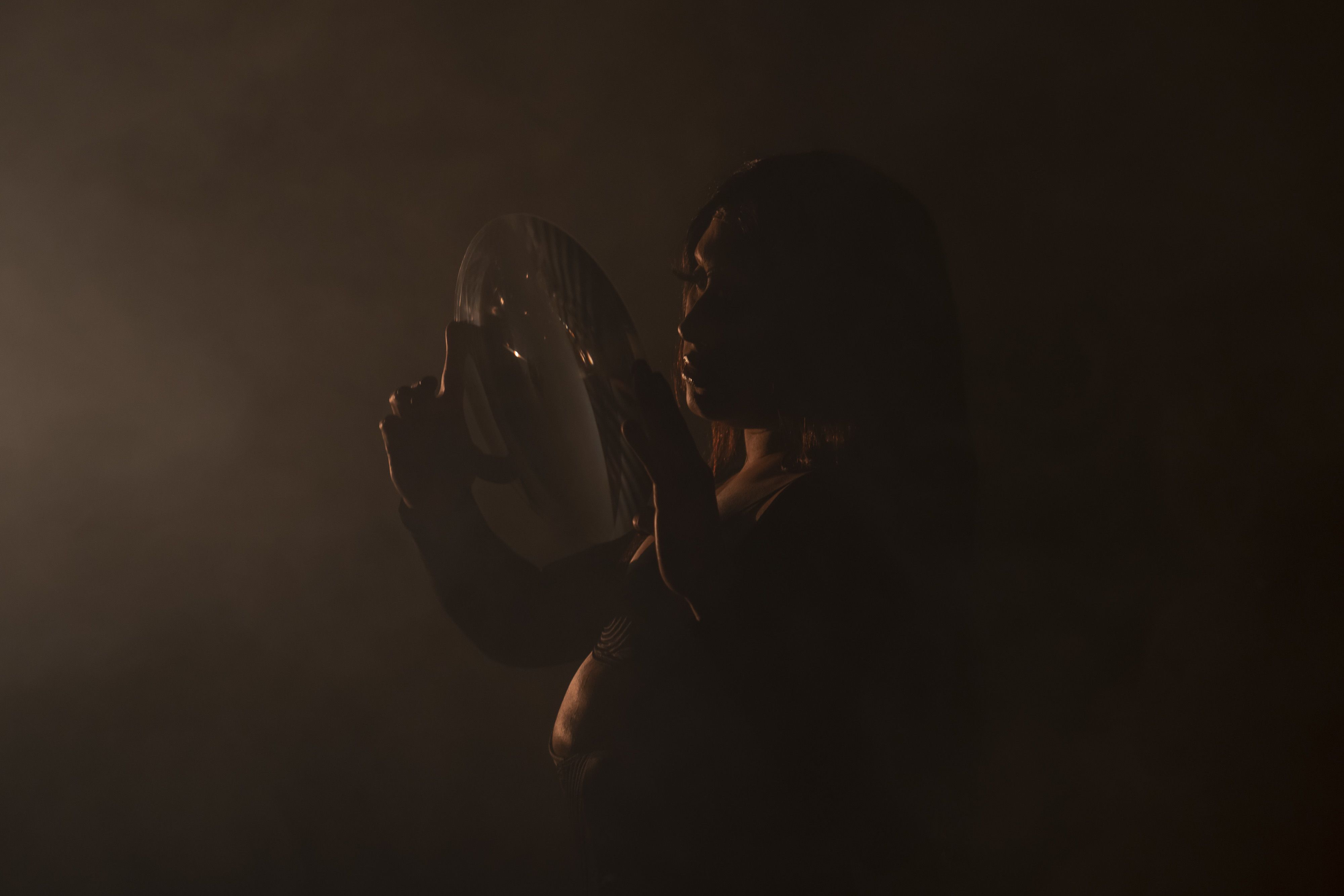
“When I think about the ways I begin to craft a performance, it's often these images that come to mind,” Campos said. “I’ll have this starting image, this thing that people first see, like a tableau, or an installation, or a quality of light.”
In Chicago, drag performers have always been more than entertainers. They are artists, performers, comedians, fashion designers, hosts, activists, and more—all at once. Chicago drag traces back to the late 1890s, emerging from the underground clubs and speakeasies of Bronzeville and the historic neighborhood of Towertown, and as drag becomes more mainstream, Chicago drag continues to reflect a legacy of experimentation and hybridity, shaped by artists who treat performance as a playground for creativity and spectacle.
Over the years, SAIC has influenced the drag scene, too. Many alums have used drag as a medium for their best work, like SAIC and RuPaul’s Drag Race alum BenDeLa Creme (SAIC 2002–03) who first started performing as part of a Chicago drag performance troupe, and SAIC alums Kenzie the Dragon, JForPay, and Grace Duval (MFA 2015), who use their drag as a meeting point for fashion, performance, and installation. Today, SAIC alums Campos and Abhijeet Rane (SAIC 2016) carry that lineage forward, embodying the multidisciplinary artistry that defines SAIC while helping drive the electric, culture-shifting engine that is Chicago drag.
Ále Campos AKA Celeste
Before coming to SAIC, Campos studied photography at a liberal arts college in Vermont. Two years after graduating and moving to Hudson, New York, they began performing in drag for the first time at Lil’ Deb’s Oasis, a queer-owned local restaurant. There, they hosted Queer Night of Performance, a monthly variety show where Campos and other queer artists took to the stage to perform for their community.
Here, Campos began developing their drag persona, Celeste: experimenting with makeup and fashion, donning blonde wigs, cowboy hats, and sparkly red dresses while performing passionate lip syncs to songs like “Power of Love” by Celine Dion. After performing for a few months, Campos eventually settled on the name Celeste after talking to a friend with the same name about Latina performers like Celia Cruz, Selena, and La Lupe. The name Celeste reminded Campos of these iconic women and the sensual, feminine energy they wanted to exude in their own performances.
The more Campos performed as Celeste, the greater they desired to establish themselves not only as a drag performer, but as an artist who could use their art to connect with people, build queer community, and as Campos put it, “convey my legitimate experiences as a human being.” A mentor encouraged them to apply to study at the School to gain a foundation of performance art knowledge and theory to build their burgeoning practice upon.

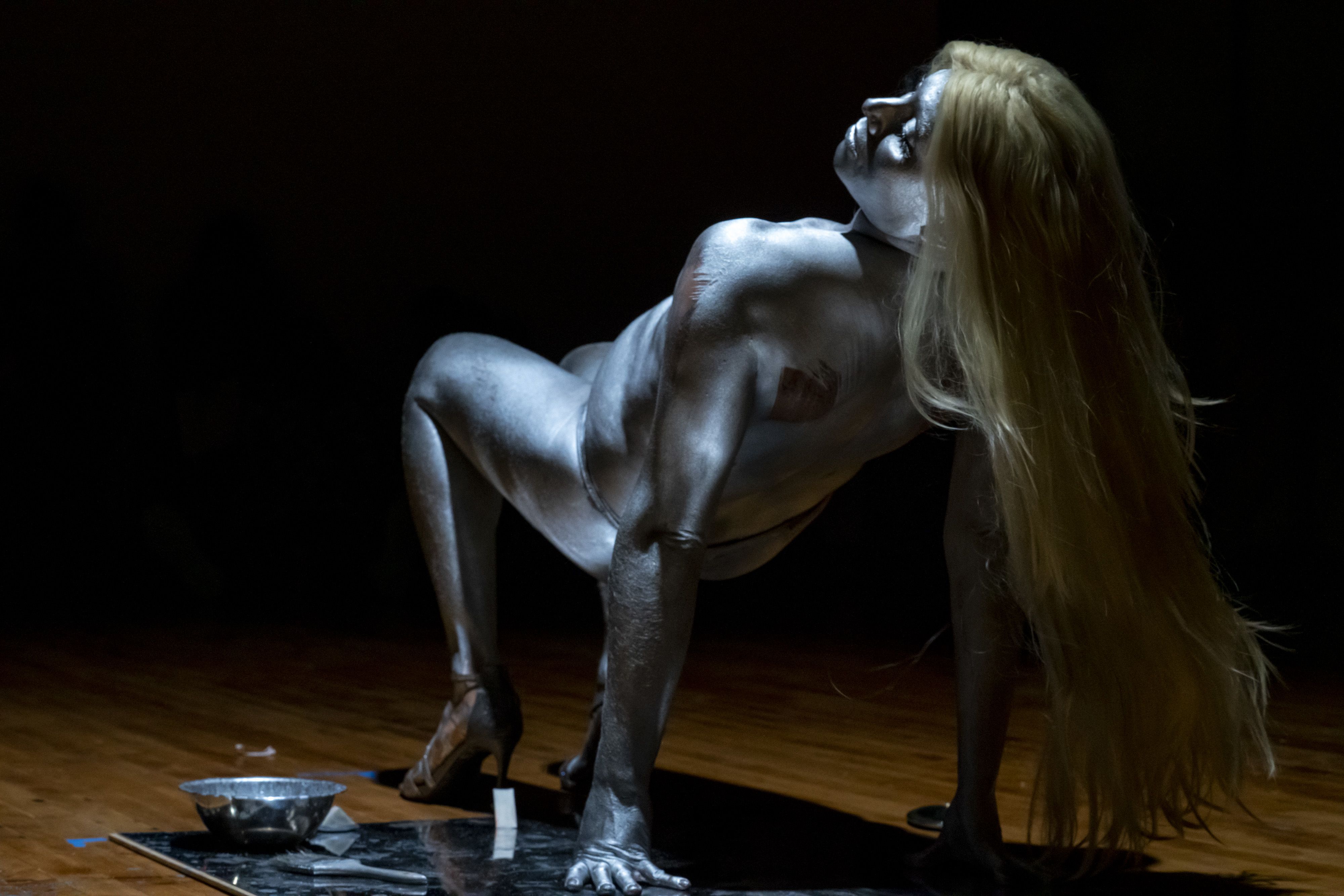
As Celeste, Campos performs across Chicago, from clubs to galleries and beyond. Image Courtesy of Colectivo Multipolar
As Celeste, Campos performs across Chicago, from clubs to galleries and beyond. Image Courtesy of Colectivo Multipolar
“When I think about the ways I begin to craft a performance, it's often these images that come to mind,” Campos said. “I’ll have this starting image, this thing that people first see, like a tableau, or an installation, or a quality of light.”
When Campos arrived in Chicago for the first time, they were introduced to all the potential the city holds for art-making, both in and out of school. Fellow students and peers helped them get to know Chicago by visiting galleries and art shows. They would also take Campos to parties, clubs, and bars, introducing them to Chicago nightlife and the people that drive the scene.
“I met so many other people that are still a part of my sphere in terms of the art world here. I think Chicago really opened itself up to me very quickly,” Campos said of their time as a student at SAIC. “I think SAIC obviously had something to do with that, just thinking about the presence of community in and around and from the School.”
In Chicago, their education happened along two complementary tracks. Within the School, they worked toward their master of fine arts in performance, which culminated in a multimedia experience where Campos appeared as Celeste in front of a green screen backdrop which digitally transported them to various natural landscapes. Outside of the School, they debuted Celeste to Chicago at raves, clubs, bars, and even at drag competitions like Crash Landing at Berlin Nightclub—an iconic, now-closed staple of Chicago queer nightlife—where they eventually won one of their competition cycles. Beyond Chicago's drag scene, their work also resonated with the city’s local arts scene. They became a resident at the Chicago Arts Coalition, exhibited a video performance project which was displayed onto the Hyde Park Art Center building, and were named a Breakout Artist by Newcity magazine in 2023.
In addition to performing at a number of venues across the city like Thalia Hall, The California Clipper, Podlasie Club, and Steppenwolf Theatre, Campos also performed and co-produced a monthly party called Rumors at Dorian’s in Wicker Park. They have also exhibited their work in galleries and spaces across Chicago like Roots & Culture, Co-Prosperity, The Poetry Foundation, Comfort Station, and Elastic Arts.
Drag lets Campos inhabit a dynamic intersection of creativity. Their performances blend technology, video, and sound with live performance and visual art. Their Celeste persona helps Campos heal their inner child while also channeling their mother and other ancestors across the Latin diaspora. Drag lets Campos express themselves in many forms, in many ideas, all at once. Each venue, from nightclubs to galleries, allows them an opportunity to convey an essential truth about themselves as an artist.
“It's about being able to express myself,” Campos said. “To see myself across all of it.”
Abhijeet Rane
On stage at the Steppenwolf Theatre, rhinestones and pearls on Rane’s blush pink gown sparkle underneath the beam of bright spotlight. A plucked-string melody plays as Rane lifts a pink mesh veil from their face, revealing a smile that shines as brilliantly as their dress. With graceful hands that extend towards their audience, Rane begins a lip sync performance of “Dil Cheez Kya Hai,” a song originally performed by Indian singer Asha Bhosle which was featured in the classic Indian film Umrao Jaan.
“I really enjoy being something that is larger than life,” Rane said. “I don't really like existing in reality. With the way I do drag, there's always some element of spectacle or scale to it.”
As a drag artist in Chicago, Rane can be found all across the local nightlife and performance scene as a performer and a producer. They host Dim Sum and Drag, a drag brunch series showcasing Asian American and Pacific Islander performers. They performed in a Steppenwolf cabaret which expressed themes of queer identity through the visual language of South Asian cinema. Along with DJ Kirk, they co-organize BOOTS, where they throw parties at unconventional venues, including a dim sum restaurant, the Hairpin Arts Center, and on the rooftop of Center on Halsted.
When Rane moved to Chicago from Mumbai to attend SAIC, they initially wanted to study painting. However, in their first semester of school, Rane chose to take a research class that explored new media art, event production, and sound technology, and they also took an introductory performance art class where they first learned about artists like Leigh Bowery, whose radical, avant-garde approach to performance-making and fashion started influencing their own art.
“I really enjoy being something that is larger than life,” Rane said. “I don't really like existing in reality. With the way I do drag, there's always some element of spectacle or scale to it.”

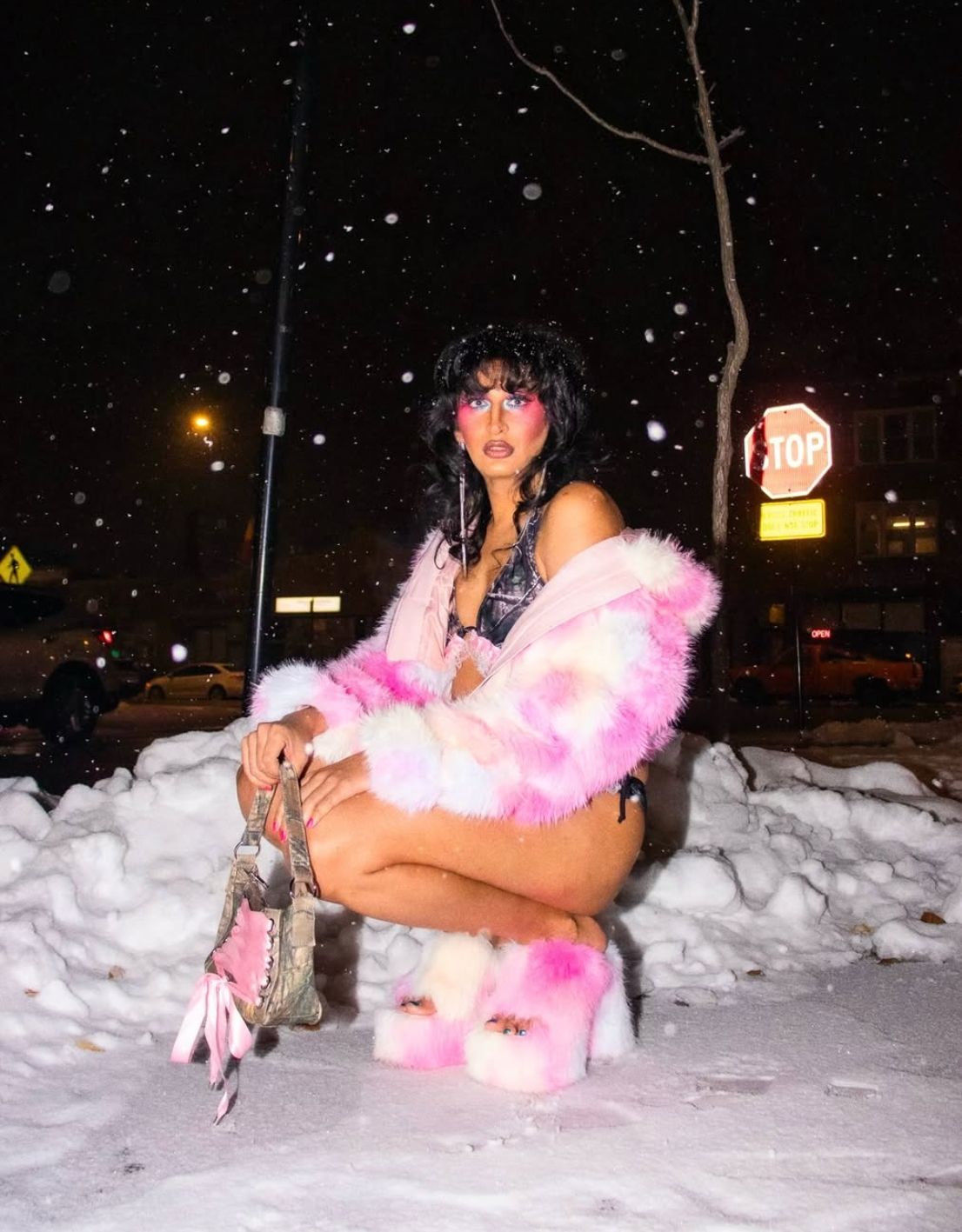
Rane braves the Chicago winter.
Rane braves the Chicago winter.
Outside of school, they visited Chicago clubs, gained a lot of inspiration from local drag queens, and eventually started performing in drag while they were still an SAIC student. Weekly open stage competitions became a place to experiment with their appearance. Club kid fashion and culture inspired them to create their own outfits, incorporating unconventional materials like Starbucks labels and paper airplanes. They created bold makeup looks that expressed fluidity across the gender spectrum. Through this process of discovery, Rane realized that embodying the intersections of their identity as a queer South Asian person was integral to their identity as an artist. Drag became the ideal place to keep exploring.
“For me it's like, why make impersonal art?” Rane said. “Why create something if it's not also telling a story about yourself in some way?”
Rane likes to blend drag with cultural elements like Indian cinema to express all of who they are as a person and artist. Drag also gives them a way to spark connections with people wherever they perform—with a person in a crowded club, with a seated audience member in a theater, with other drag queens. Knowing that fine art can sometimes feel inaccessible to a broader audience, making their performances open and approachable is key in Rane’s artistic practice. For Rane, drag is the perfect way to create special, shared experiences for people to live inside.
“ When you work in drag or nightlife, there's such an importance placed on how you make other people feel,” Rane said. “You can make a moment last for someone for a lifetime.” ■
 Built with Shorthand