
Matteo Lane’s Obsessions

by Ben Kim Paplham (MFA 2021)
Illustrations by Luis Carrasco
As a kid reading comic books and drawing animations on a lightbox, or as a teenager trained in opera singing, or as a School of the Art Institute of Chicago (SAIC) student studying oil painting, or later in New York City working as a storyboard artist for commercial campaigns, Matteo Lane (BFA 2009) has many talents and paths his life could have followed. But it was stand-up comedy, first begun at open mics as a Chicago art student, that became his greatest passion.
Two decades later, Lane has risen to comic stardom. He’s appeared on The Late Show with Stephen Colbert and Late Night with Seth Meyers; he was a featured comedian on Netflix’s The Comedy Lineup; his hour-long comedy special Matteo Lane: The Al Dente Special can be found on Hulu; and he’s even written a cookbook called Your Pasta Sucks: A “Cookbook.”
Next up is a world tour: 31 shows, eight countries, and 27 cities during a 125-day span through May 22. But before Lane hits the road (and the airports), he sat down with us to discuss a few of his recent obsessions.

FoRTNITE
I’ve been playing Fortnite since 2020—Bob the Drag Queen got me addicted. I play with my friend Nick Smith, who I host the podcast (I Never Liked You) with. We play with this group of guys we met online in 2020 and became best friends with. Me and Nick, gay as the day is long; these guys, straight hockey players, live in Pittsburgh—we talk to each other every single day; we play for hours every single night. I’ve taught them a lot about Liza Minnelli! And I’ve gotten so good because they were so skilled when I first started playing and I was not. I’ll be the Red Storm Trooper, or I’ll be the Scarlet Witch, and it’s so much fun, running around with a huge gun while just also in heels and a dress. Fortnite is incredibly gay, and it’s the only place where, like, Eminem and Ariana Grande and Homer Simpson and the Emperor Palpatine can all be in the same place.

Carrie Fisher’s Wishful Drinking
I just re-read Carrie Fisher’s book Wishful Drinking. I’ll go back once a year and read that book because there’s just something about Carrie Fisher. She played Princess Leia, obviously, but people don’t know how good of a writer she was and how funny she was. She talks all about her life, through addiction and electroshock therapy. She’s just got a very fascinating life, and she’s very funny about it. I try to read books that I think are going to make me laugh or will at least inspire me to think in a different way, so I usually go for comedians’ books like Carrie Fisher’s or John Waters’ books, or I’ll still read comic books.
Plane Portraits
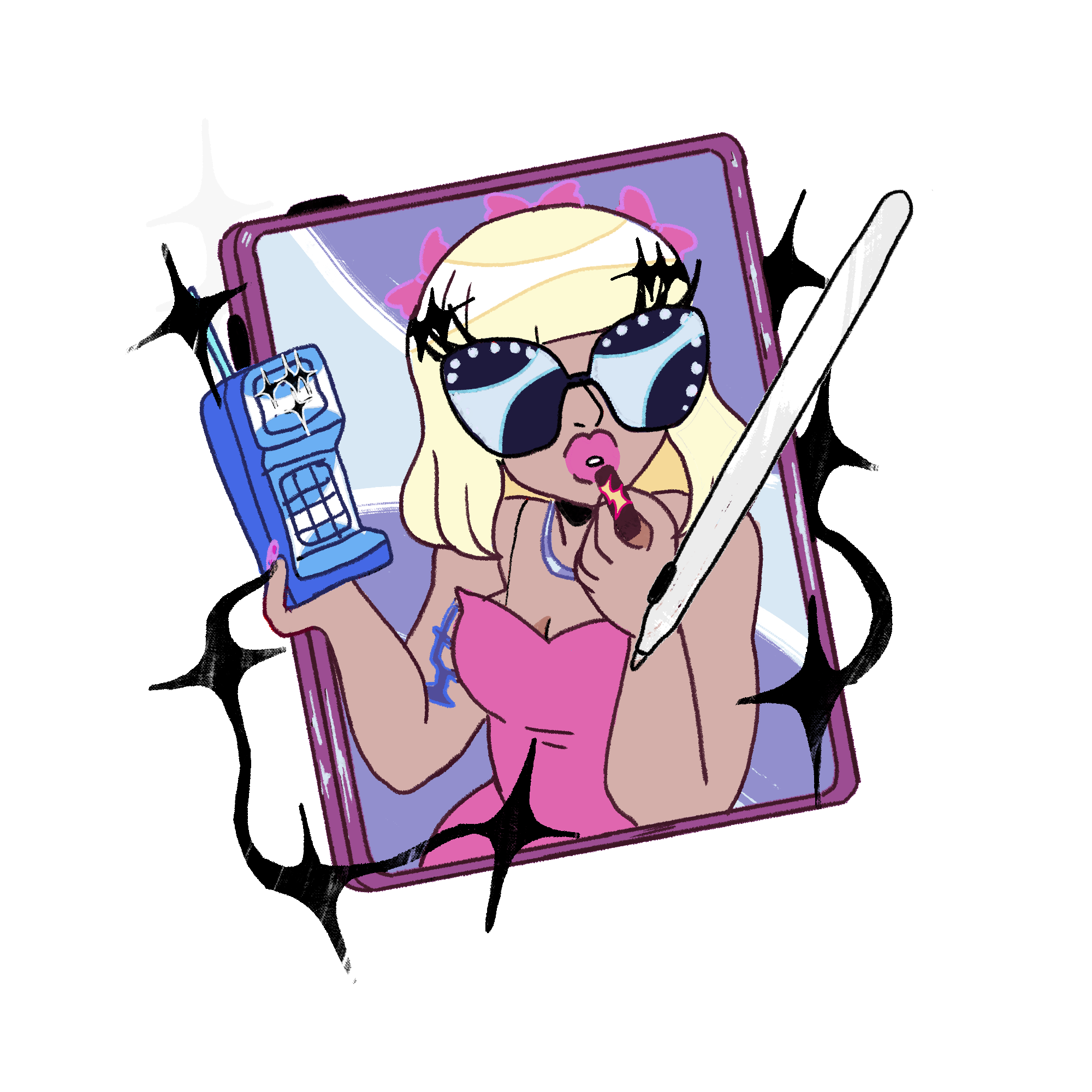
When I’m bored on a plane, I use my Wacom tablet or Procreate on my iPad. You can do oil paintings on there and, seriously, if I sat down right now and you asked me to do storyboards or ask me to draw a comic book, I could still do it. This is something I’ll draw on a plane. Here’s Lady Gaga: she was at an award show—the Met Gala, I think. Then I’ll do a portrait of John Singer Sargent. Hades from Hercules, and Maleficent. And here’s a drawing of Fran Lebowitz. I was always interested in drawing portraits, for sure. When I was studying in Italy for a summer abroad program, I lived in an old convent. I had just a bed in my room—that’s all I could fit!—and we had a studio that used to be a church. My friend, now a very well-known comic book artist, and I were obsessed, and we would just paint as much as we could: the landscapes, the town square, a cup of coffee, and we’d have people in town sit for us.
CRAFTING MATERIAL
Crafting jokes and crafting material into an hour, into a special—that’s the stuff that I really like to do. But you have to work from general to specific. I learned this from [Associate Professor] Dan Gustin, who was a painter at SAIC, and [Associate Professor, Adj.] Peggy Macnamara when I took her scientific illustration classes. SAIC was the best thing that ever happened to me, absolutely, and I mean that.
But everything has to start. You can’t immediately go into the detail of the hand; you have to form the body and then work into the specifics. Then I have to do the process over and over again to wash away everything that gets in the way from my mind to my hand. The process is about making it easier to express myself.
Stand-up is the same. I can’t just go onstage and express myself. I have to learn what my voice is in a joke. How do I stand onstage? How do I hold a microphone? How do I deal with a heckler; what do I do with a bad audience; how do I work when I’m tired; how do I adapt if this joke doesn’t work; how do I build five minutes, to 15 minutes, to 40, to an hour. You have to learn everything you can about the fundamentals. Talk to people around you; watch them. You have to fail in front of an audience and rework those jokes till they work, and that process is something that I really love. No art can be passive. You have to be obsessed with it. ■

 Built with Shorthand