
JJJJJerome Ellis on Time, Stuttering, and the Archive


by Sophia Salganicoff
In 2024, a seafoam green billboard went up in New York City. In sans serif text in multiple languages, it read: “stuttering can create time.”
In English, the word stuttering is interrupted by elongated lines that force the eye to pause from the street. The billboard, commissioned from artist JJJJJerome Ellis and their collective People Who Stutter Create (with fellow members Jia Bin, Delicia Daniels, Conor Foran, and Kristel Kubart) for the Whitney Biennial, extends the artist’s longstanding interest in delay, repetition, and disruption into the landscape, where language competes with speed, signage, and noise.

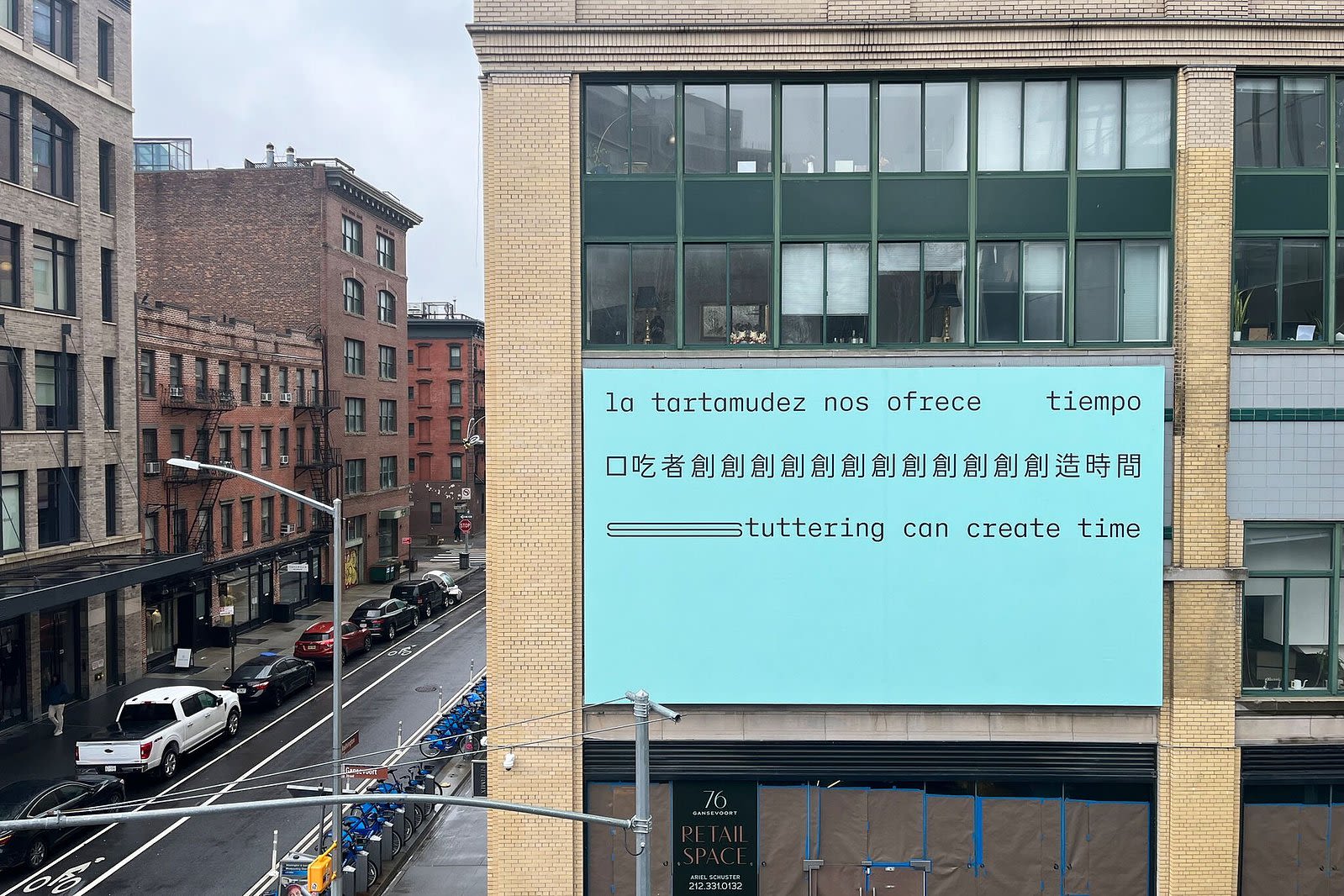
The billboard created by JJJJJerome Ellis and their collective, People Who Stutter Create.
The billboard created by JJJJJerome Ellis and their collective, People Who Stutter Create.
“I’ve stuttered since I was like four or five,” said Ellis. “Because it pauses the conversation, I feel this dilation or expansion of a moment.”
“If each moment, each nanosecond, is a bubble,” Ellis said, “my experience of stuttering is like when you blow air into a bubble and it expands.” Ellis works across sound, text, performance, video, and archival documents to study how Blackness, disabled speech, divinity, and music shape time. This spring, Ellis discussed their practice at the School of the Art Institute of Chicago as part of the Visiting Artists Program on March 24.
“I’ve stuttered since I was like four or five,” said Ellis. “Because it pauses the conversation, I feel this dilation or expansion of a moment.” What might register to others as hesitation or interruption becomes, in Ellis’s experience, a temporal opening. Time stretches. Attention sharpens. Meaning gathers rather than collapses. That expanded moment shapes how Ellis works across many mediums.
Even the spelling of their first name reflects Ellis’s relationship to time. The extended consonants in “JJJJJerome” visually register delay and repetition, echoing the stutter not as error but as authorship. For Ellis, stuttering does not interrupt communication—it reorganizes it.

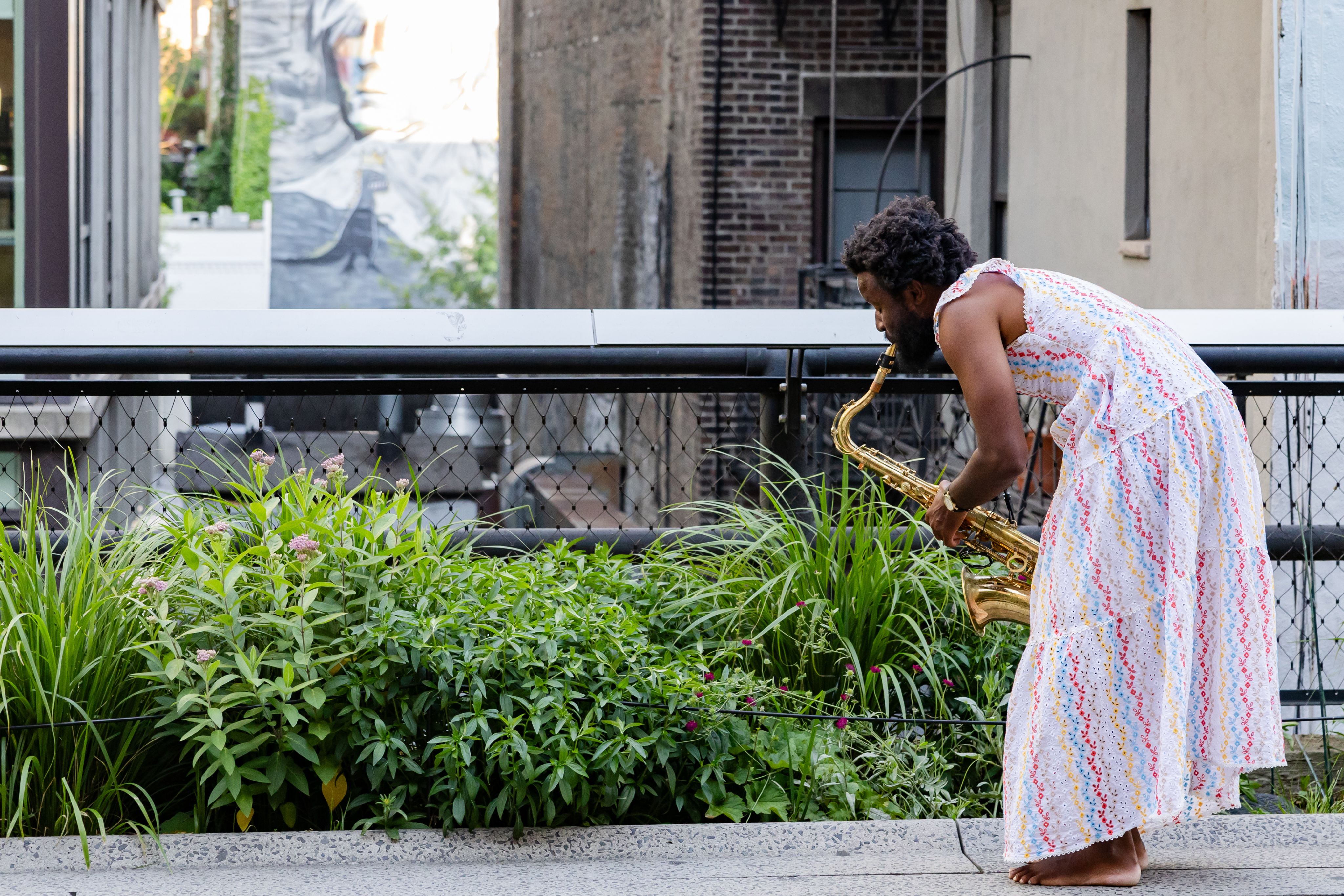
Ellis performs Music for the Garden, commissioned and produced by High Line Art, presented by the High Line and NYC Parks. Photo by Liz Ligon.
Ellis performs Music for the Garden, commissioned and produced by High Line Art, presented by the High Line and NYC Parks. Photo by Liz Ligon.
“I began as a musician,” Ellis said, “but I have since branched out to work with text, performance, theater, photography, and video. I like to translate across different media.” Their body of work includes contemplative soundscapes built from saxophone, flute, dulcimer, electronics, and voice; music-video poems that rework historical documents; and collaborative performances shaped by vulnerability and trust. Across these forms, Ellis returns to the same question: what happens when time is opened rather than resolved?
In The Clearing, their 2021 album and book, Ellis names this inquiry directly. “My thesis is that Blackness, dysfluency, and music are forces that open time,” they said. “I had long experienced my stutter as having this effect on time, even before I put language to it.”
Music offered a parallel structure to their stuttering. “When I use a drone [a sustained sound], it becomes a continuous sound, the end and beginning of which start to blur. It becomes this prying open of time, almost like a crowbar.” Loops and repetition become tools for lingering rather than advancing, holding space rather than moving through it.

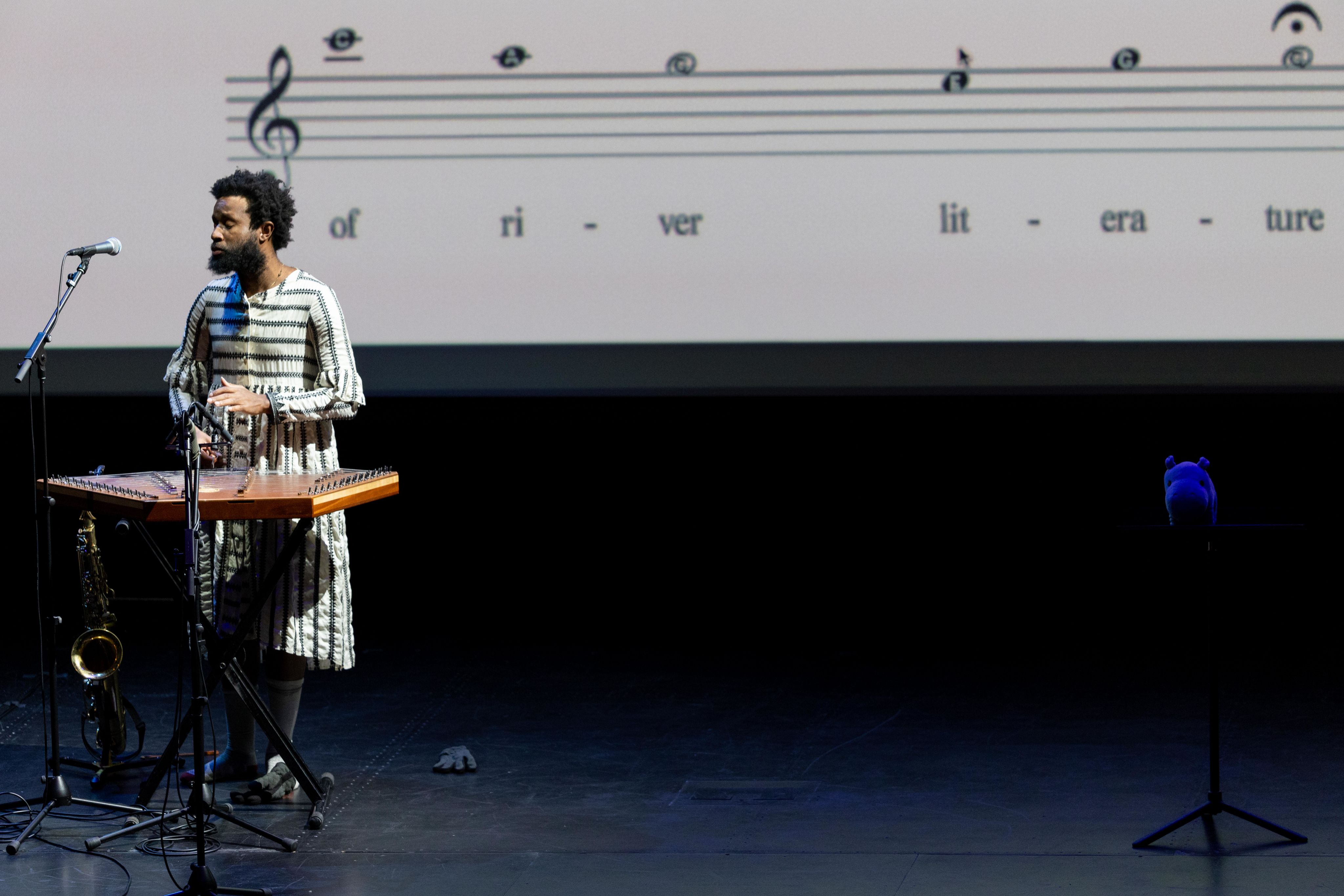
Ellis performs Aster of Ceremonies at UCLA Nimoy Theater. Photo by Bailey Holiver.
Ellis performs Aster of Ceremonies at UCLA Nimoy Theater. Photo by Bailey Holiver.
“When I try to write about something contradictory, it feels hard,” Ellis said. “But when I make music about that thing, the music allows me to hold the contradiction easier.” Often, the process moves both ways. “Sometimes I listen to a recording of music I’ve made and write a description of it, almost like a poem that’s a translation of the music.”
This attention to translation also shapes Ellis’s approach to archives, particularly in Impediment Is Information, where they rework fugitive slave advertisements into poetry. “Those archives are written by enslavers,” Ellis said, “and I felt total license to do whatever I wanted with their words. At the same time, they’re writing about the enslaved, and I felt such responsibility toward the ancestors being written about.” The document binds both parties together, making the work ethically fraught. “It wasn’t as simple as saying these words belong to the enslavers,” Ellis said, “because the enslaved and the enslaver are so entangled there.”
Their willingness to disrupt the archive is grounded in an understanding of state violence as ongoing rather than historical. “As a Black person,” Ellis said, “I understand that the state has practices now, as it did in the past, that make the world less safe for me and for my ancestors.”
For students navigating disruptions in speech flow, neurodivergence, or slowness within institutions structured by speed, Ellis offers solidarity rather than solutions. “It’s hard,” they said. “Something I often tell myself is, ‘It’s not my fault.’” Learning the social model of disability reframed that struggle. Time, once again, becomes a site of resistance. “Different structures are disabling,” Ellis said. “I try to think in longer time scales.”
Over time, Ellis began to understand how many of the pressures they faced around time, speech, and productivity were not personal failures but structural ones. That realization did not erase those pressures, but it clarified where they came from. “So much of my struggle around ableism comes down to the idea that [...] I’m responsible for ‘fixing’ myself,” said Ellis. Rethinking that assumption shifted how Ellis located responsibility. “It invites me to think about what is my responsibility and what is not,” Ellis said, and to make space for working, speaking, and moving at a different pace.

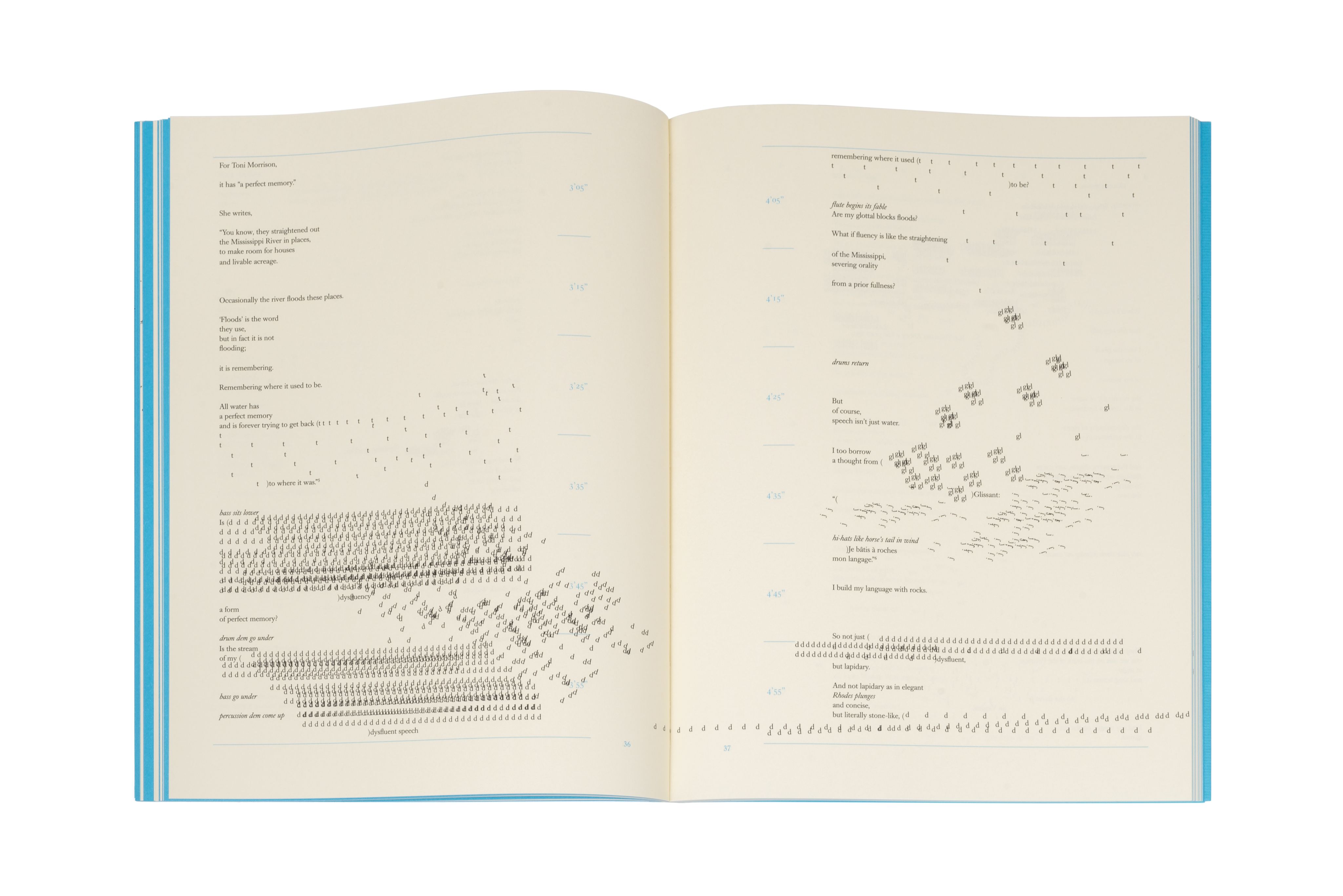
JJJJJerome Ellis, The Clearing. Designed by Rissa Hochberger, JJJJJerome Ellis, and Kelvin Ellis, published by Wendy's Subway (2021). Photo by Justin Lubliner.
JJJJJerome Ellis, The Clearing. Designed by Rissa Hochberger, JJJJJerome Ellis, and Kelvin Ellis, published by Wendy's Subway (2021). Photo by Justin Lubliner.
When the weight of systemic pressures becomes too much, Ellis emphasizes the importance of leaning on and cultivating community networks of care.“I keep a Google Doc of the kind things people have said about my work,” they said. “I turn to it when I feel lost. It has taught me so much about what we can do for each other amid systems that fail to take care of us.”
Across forms and contexts, Ellis’s work resists easy resolutions. The stutter opens time. Sound reorganizes language. The archive fractures and reforms. Contradiction remains intact. “I think of the work like seeds,” Ellis said. “Maybe one sentence connects with something someone is already thinking about, and that forms a third idea. I take pleasure in how little I know about the effect of what I make.” ■
 Built with Shorthand