
Assistant Professor Delano Dunn Celebrates a Non-homogenous Art World
Andy Warhol, Little Race Riot, 1964

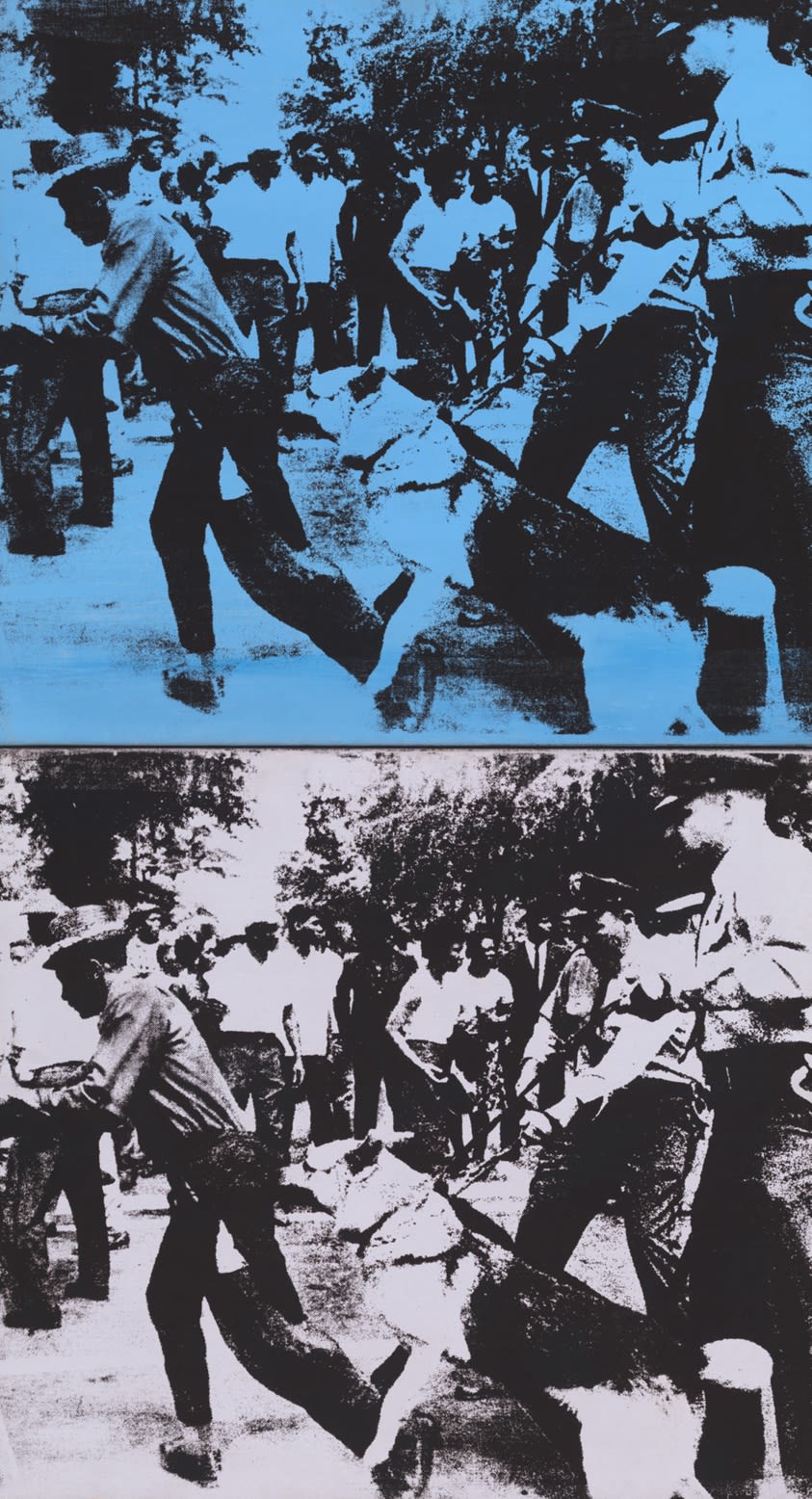
Andy Warhol, Little Race Riot, 1964
Andy Warhol, Little Race Riot, 1964
by Taylor Moore
In 1963, white police officers swarmed a nonviolent civil rights demonstration in what became known as the Birmingham riots.
In violent scenes captured by photographer Charles Moore for Life magazine, Black protestors are attacked by high-pressure water cannons and German shepherds, one of which is seen biting the pants of a man turning away. This image was immortalized by Andy Warhol in a 1964 exhibition entitled Death in America, which also featured images of electric chairs, suicides, and atomic bombs. Race Riot reproduces Moore’s photograph in a four-panel painting with white, blue, and red quadrants. The original artwork was sold for $62 million in 2014, while one of Warhol’s dozen-plus reproductions, Little Race Riot, is part of the Art Institute of Chicago collection.
The piece represents one of Warhol’s most direct political statements—but how political is it, really? Delano Dunn, mixed-media artist and assistant professor in School of the Art Institute of Chicago’s (SAIC) Contemporary Practices department, likes to examine this piece as a missed opportunity.
“I do find it to be a problematic work in that he is taking something that’s so heavy with history—even at the time—and he takes it out of the realm of being a photo about the civil rights movement and he brings it into a gallery white space,” said Dunn. “And, in my opinion, it sort of loses its value … [because it] doesn’t necessarily carry with it the impact it had outside the space.”
Dunn himself makes beautiful, subversive, and sometimes provocative collages using archival photographs to comment on minstrelsy, police brutality, and the Founding Fathers.
“There’s a lack of emotion and empathy. The original photos have danger in them. There are stakes. It is violent. In this particular work, to me, it’s soft. It doesn’t really take a position.”
Warhol is infamous for reproducing photographers’ and brands’ images in his work, which has resulted in multiple high-profile lawsuits. Moore sued Warhol for copyright infringement in a case that was settled out of court.
“If you break the work down, it's a stunning image by photographer Charles Moore which has been screen printed on canvas with color by Warhol. The Moore photo is not served or elevated by Warhol. Instead it's stripped of its power and the history it captured.”
Part of Dunn’s mission as an educator is exposing students to all kinds of works, including those that they might not like, and giving them permission to express their thoughts freely. These skills come in handy throughout students’ years at SAIC (and beyond), where critiquing and expressing artistic opinions are a major part of classroom culture.
“Ask a student and most will tell you they are uncomfortable speaking poorly of a work of art they have been introduced to by an instructor. But when students are given the agency to express counter-sentiment, they begin to build a language that will help them speak about their own work.”
Dunn’s pick highlights the breadth of the Art Institute of Chicago collection—which has served as an inspiration, discussion point, and resource for students over the School’s entire 160-year history. Ultimately, Dunn said, “There is no work of art that is loved by all. That's a good thing. No one wants a homogeneous art world.” ■
 Built with Shorthand